How to Ensure Brand Presence in AI Search Results
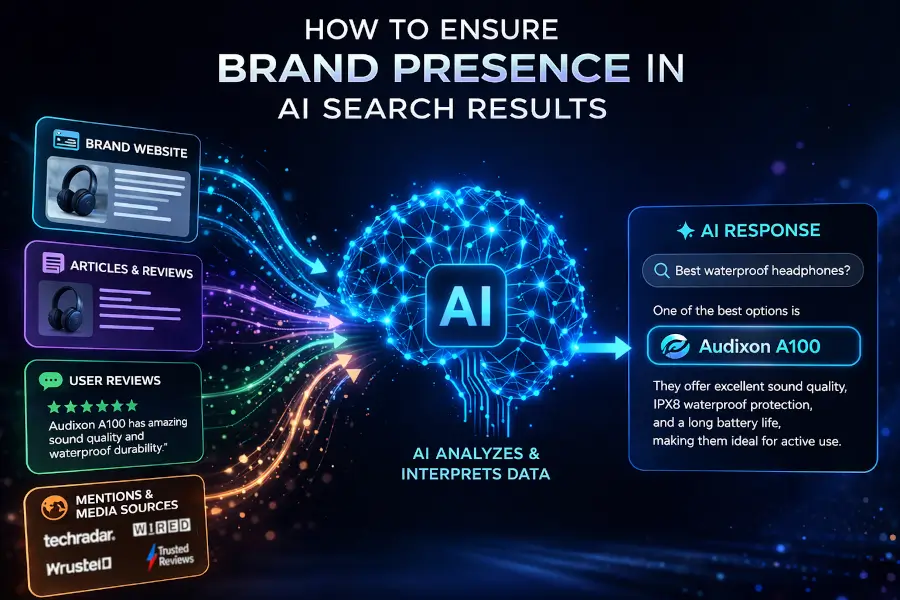
ChatGPT, Perplexity, Google AI Overviews — this is where the early stages of buying decisions now happen. If your brand doesn't appear in AI-generated answers, it effectively doesn't exist for a growing share of potential customers. This is a practical gu
1. The New Reality of Search
Before 2025, AI-sourced traffic felt like a niche metric. Then came the inflection point. Between July 2024 and February 2025, AI referral traffic in the US grew more than tenfold, according to Adobe Digital Insights. For markets with less competition, the numbers are even more striking.
The paradox is that most companies are still optimizing for Google rankings, while their potential customers are increasingly getting answers directly inside an AI interface — without clicking through to any website. Meanwhile, e-commerce is already recording a 22% drop in organic search traffic attributed to AI-generated suggestions.
2. GEO vs SEO: What's the Difference
Generative Engine Optimization (GEO) is the practice of optimizing your content so that AI systems cite or recommend your brand in their responses. Unlike traditional SEO — which fights for a position in a list of links — GEO aims to get your brand inside the AI's answer itself.
| Parameter | Classic SEO | GEO |
|---|---|---|
| Goal | SERP position | Citation inside an AI answer |
| Key signal | Keywords + backlinks | Brand authority + content structure |
| Conversion | Click on a link | Recommendation with or without a click |
| Trust signals | PageRank, Domain Authority | Third-party mentions, E-E-A-T, structured data |
| Speed of impact | Weeks to months | Weeks for new LLM queries; months for training data |
| Measurement | Rankings, organic traffic | AI citation count, share of voice in AI |
3. How AI Chooses Sources to Cite
Research from Princeton, Georgia Tech, and the Allen Institute identified clear citation patterns: 32.5% of AI references go to comparative articles and roundup-style content. The shortest path to AI visibility isn't your own website — it's being mentioned in the sources AI already trusts.
AI search is fundamentally different from traditional search. These systems analyze intent and context, not keyword density. Queries of 10 or more words trigger an AI-generated answer 53% of the time, compared to just 8% for single-word queries. This means high-intent, informational queries are exactly where the battle for AI visibility plays out.
"AI search works on intent, not keywords. It reads content, then grounds answers with sources." — Search Engine Journal, September 2025
The core principles AI systems follow when selecting sources to cite:
- Third-party authority — AI trusts what others say about you more than what you say about yourself.
- Content freshness — AI platforms favor content that is on average 25.7% more recent than what traditional search typically cites.
- Structural clarity — content with clear structure, descriptive headings, and FAQ blocks is far easier for AI systems to parse and extract.
- Semantic depth — broad coverage of a topic from the perspective of entities and relationships between them, not just keywords.
- Cross-platform presence — brands that appear on Reddit, LinkedIn, in G2/Trustpilot reviews, and in journalist coverage build a clearer "trust profile" that AI systems can recognize.
4. Structured Data as the Technical Foundation
In March 2025, Fabrice Canel from Microsoft Bing confirmed that schema markup helps Microsoft's LLM models understand content for Copilot. In April of the same year, Google stated that structured data provides a ranking advantage. ChatGPT issued equivalent confirmation for product results.
Pages with properly implemented schema markup appear in AI answers 3.2 times more often than pages without it (analysis of 73 sites, 2025). For FAQPage schema specifically, Relixir found an even clearer gap: a 41% citation rate versus 15% for pages without it.
Which schema types matter most for GEO
Practical example: Organization schema
The Organization and Person schema types allow AI systems to accurately understand who you are as a brand — your name, industry, founders, and social profiles. Without them, LLMs are forced to "guess" your brand's identity and may confuse you with companies that share similar names.
<script type="application/ld+json">
{
  "@context": "https://schema.org",
  "@type": "Organization",
  "@id": "https://yoursite.com/#organization",
  "name": "Your Brand Name",
  "url": "https://yoursite.com",
  "logo": "https://yoursite.com/logo.png",
  "description": "A clear, specific description of what you do",
  "foundingDate": "2018",
  "sameAs": [
    "https://linkedin.com/company/yourbrand",
    "https://twitter.com/yourbrand",
    "https://g2.com/products/yourbrand"
  ]
}
</script>
5. Content That AI Systems Actually Quote
AI systems don't rank pages — they search for answers to specific questions. This fundamentally changes how content should be written.
Structure that AI can parse
Short paragraphs (2–4 sentences), clear H2/H3 subheadings, FAQ blocks, and numbered instructions are exactly the formats AI can easily extract and insert into answers. Long, monolithic blocks of text without structure are frequently ignored entirely.
Structure sections as "What is X?", "How do you do Y?", "Why does Z matter?" — this directly mirrors the format of questions people ask AI systems.
Packing text with keywords without a clear answer structure is an old SEO approach that doesn't translate to GEO. AI looks for explanations, not term density.
TL;DR and summary blocks
Open articles with a short executive summary (2–3 sentences answering the main question) and close sections with a "Key Takeaways" block. These are the first things AI systems extract — and they're often cited verbatim.
Statistics and specificity
Numbers, dates, company names, and concrete claims significantly increase the likelihood of being cited. "40% growth" outperforms "significant growth" every time. AI systems strongly favor verifiable facts with clear attribution.
6. Third-Party Mentions and UGC
This is probably the most underestimated aspect of GEO. AI systems trust what others say about you. As of October 2025, Reddit, LinkedIn, and YouTube ranked among the top sources cited by leading LLMs. The share of user-generated content in AI citations has grown to 21.74%.
Where your brand needs to be present
- Reddit and Quora — participate in relevant threads where people discuss your product category. Not promotional posts, but genuinely useful answers with real insight. Reddit citations in AI Overviews grew from 1.3% to 7.15% in just three months.
- G2, Capterra, Trustpilot — customer reviews on these platforms are a classic "independent validation" signal. AI sees them as reliable third parties.
- LinkedIn posts — thought leadership from founders and key company voices. Personal authority reinforces organizational authority.
- Trade media and journalists — a single mention in an authoritative publication can shape how multiple LLMs describe your brand more effectively than a hundred corporate blog posts.
- Wikipedia — if your brand is sufficiently well-known, having a Wikipedia entry substantially improves the accuracy of AI descriptions of your company.
How to find your citation gaps
A citation gap is when AI cites pages that mention your competitors — but not you. This is the most cost-effective GEO opportunity: you need to secure mentions on the specific pages AI already trusts in your niche.
Practical approach: enter 10–15 purchase-intent queries in your category into ChatGPT, Perplexity, and Gemini. Note which sources get cited. If your competitors appear there and you don't — those are your priority targets for PR and content placement.
7. How to Measure AI Visibility
Standard Google Analytics will show ChatGPT or Perplexity traffic as referral — but that's only a fraction of the full picture. Most AI interactions leave no trace in your analytics: the user got their answer and moved on. This is why a separate measurement system is needed.
GEO metrics
| Metric | What it measures | How to collect it |
|---|---|---|
| Brand Mention Count | How often the brand appears in AI responses | Manual testing of 10–15 queries / GEO tools |
| Share of Voice | Your brand's share of AI mentions across the category | OtterlyAI, Writesonic GEO, Semrush Enterprise |
| Citation Accuracy | How accurately AI describes your brand | Compare AI responses against official positioning |
| Platform Coverage | Which AI platforms mention the brand | Manual testing across ChatGPT, Perplexity, Gemini, Claude |
| AI Referral Traffic | Direct traffic from AI platforms | GA4: filter by chat.openai.com, perplexity.ai, etc. |
A minimal process to start with
If there's no budget for specialized tools, begin with a manual audit once a month: select 15 queries that reflect key purchase intents in your niche, run them through ChatGPT, Perplexity, and Gemini. Record whether the brand appears, how it's described, and which sources are cited. This gives you a baseline "AI Visibility Index" to track over time.
8. First-Month Action Checklist
| Task | Notes |
|---|---|
| Identify 15 AI queries in your niche and run a manual audit | Log in a spreadsheet: brand present / absent, which competitors appear |
| Implement Organization schema on the homepage | JSON-LD, including sameAs for all social profiles and review platforms |
| Add FAQPage schema to 5 key pages | Validate using Google Rich Results Test |
| Restructure your 3 highest-traffic articles using GEO principles | Short paragraphs, question-based headings, TL;DR block at the top |
| Identify citation gaps and build a PR target list | Which pages does AI already cite in your space, but without your brand? |
| Create or update your G2 / Trustpilot profile | Full profile with description, categories, and responses to reviews |
| Publish 1–2 thought leadership posts from a founder account on LinkedIn | Link to the company in every post — make the connection explicit |
| Set up AI referral traffic tracking in GA4 | Filter by: chat.openai.com, perplexity.ai, gemini.google.com |
🎯 Key Takeaways
- ✔ GEO and SEO complement each other — don't abandon traditional optimization, but add a dedicated layer of work targeting AI systems.
-
✔
Structured data (
FAQPage,Organization,Article) is the technical foundation. Without it, AI systems are left guessing who you are. - ✔ Third-party mentions matter more than your own content. AI trusts what others say about you on Reddit, G2, and in press coverage.
- ✔ Content with a clear Q&A structure, data points, and a TL;DR is cited 2–3× more often than unstructured text.
- ✘ Don't wait for competitors to claim the "slots" inside AI answers. 47% of brands still have no GEO strategy — the window of opportunity is still open.
- ✘ Don't rely on a single AI tool for monitoring. Different platforms (ChatGPT, Perplexity, Gemini, Claude) cite different sources.