Why Do You Need to Update Your PHP Version?
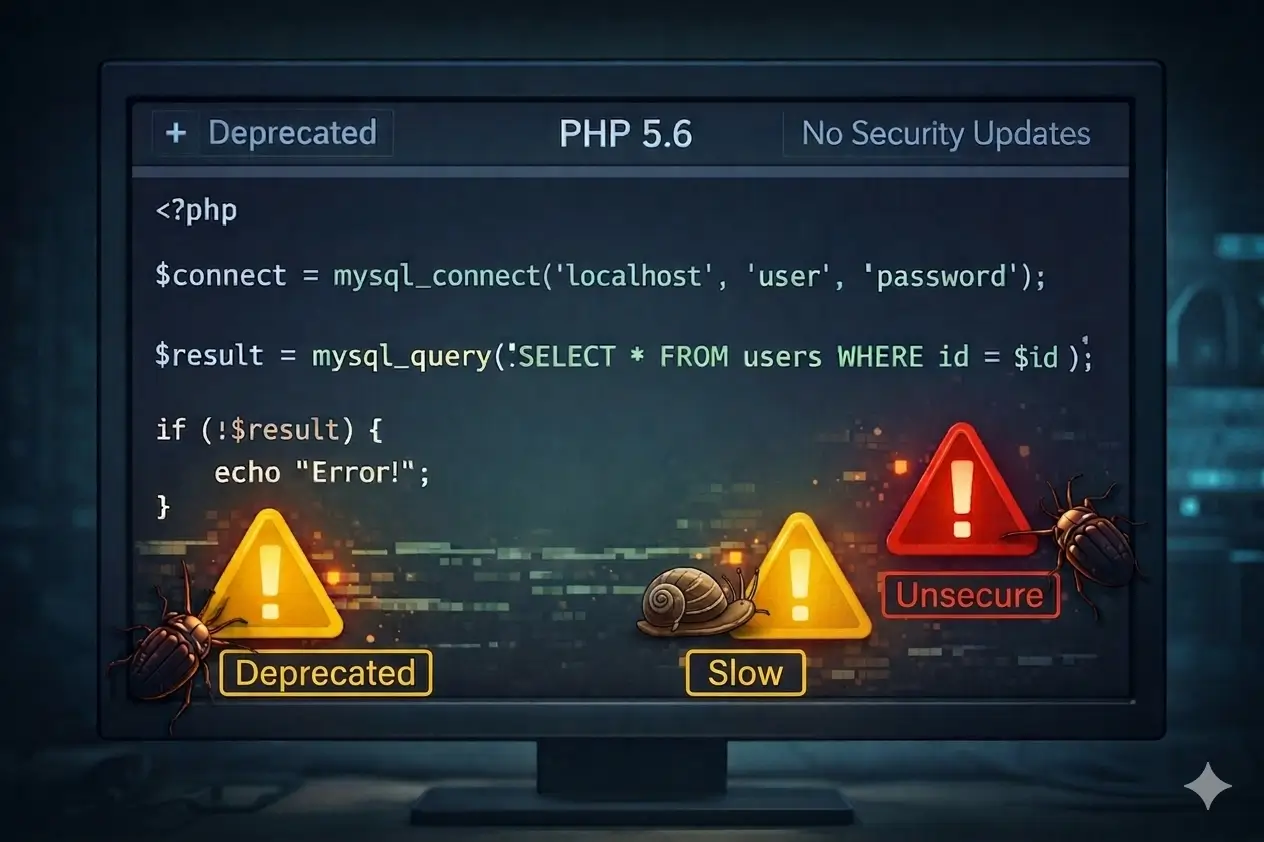
Outdated PHP is not just a support problem — it is a performance bottleneck, a security liability, and a compatibility wall. This article breaks down every reason to upgrade, backed by real benchmark data, official EOL timelines, and a practical
1. The State of PHP in the Wild
PHP powers more than 75% of all websites with a known server-side language. That is impressive — but behind that number hides a less flattering reality: a significant portion of those sites run on versions that are no longer maintained. PHP 7.x, which reached end-of-life in November 2022, still accounts for a large share of production deployments. PHP 5 — unsupported since December 2018 — can still be found on shared hosting servers around the world.
The reasons are always the same: "it still works", "we have no time to migrate", "our hosting does not support newer versions". This article is for teams that need concrete arguments to justify the investment in upgrading.
2. Performance: Numbers Don't Lie
The single most impactful performance leap in PHP history was the introduction of the Zend Engine 3 in PHP 7.0 (2015). It delivered roughly double the throughput of PHP 5.6 on the same hardware. Every major release since then has continued that trend, with PHP 8.x adding JIT compilation, fibers, and a stream of engine-level micro-optimisations.
2.1 Requests per second — WordPress benchmark
The following chart shows requests per second (higher is better) for a standard WordPress homepage under load, measured on identical hardware across PHP versions. Data is representative of community benchmarks published by Kinsta and php.net contributors.
The jump from PHP 5.6 to PHP 7.0 alone delivers more than 2× throughput at zero infrastructure cost. Moving from 7.4 to 8.3 adds roughly another 72% on top of that. In concrete terms: a server handling 100 requests/second on PHP 5.6 could serve ~500 on PHP 8.4 with the same hardware.
2.2 Execution time — synthetic micro-benchmark
The chart below shows relative execution time (lower is better) for a synthetic workload that includes array operations, string manipulation, and object instantiation — a pattern common in CMS and e-commerce back-ends.
PHP 8.3 completes the same workload in roughly 24% of the time PHP 5.6 needed. That is a 4× speedup, and it translates directly into lower CPU usage, faster page generation, and reduced cloud hosting bills.
Even a modest migration from PHP 7.4 to PHP 8.3 typically yields 60–70% better throughput on the same server — equivalent to nearly doubling your capacity for free.
3. Support Lifecycle & EOL Timeline
PHP uses a predictable three-phase release lifecycle: Active support (bug fixes + security patches), Security-only support (security patches only), and End of Life (no patches at all). Each branch typically receives active support for two years and security-only support for one additional year before going dark.
The timeline below maps every PHP branch from 7.2 through 8.4 across calendar years, making it easy to see which versions are still receiving any form of support as of 2026.
The EOL date is not just a formality. After that date, newly discovered vulnerabilities — no matter how critical — will never receive an official fix. Your only options become unofficial community patches (rare and often incomplete) or migration.
4. Security: The Hidden Cost of Staying Behind
End-of-Life PHP versions accumulate unpatched CVEs at an accelerating rate. PHP 5.6 has hundreds of known vulnerabilities with no official patches. Running it on a public-facing server is not a calculated risk — it is an open invitation.
Key vulnerability classes in older PHP versions
Modern PHP introduces strict typing, improved password hashing APIs, random_bytes()
and random_int() for cryptographically secure randomness, and engine-level protections
against certain memory-safety bugs. These are not features you can polyfill — they require
running a current engine.
"Security is not a feature you add on top — it's baked into the runtime." PHP RFC: Fibers and Security Design Notes — wiki.php.net/rfc
No security patches. Hundreds of unresolved CVEs. PCI-DSS and GDPR compliance becomes nearly impossible to maintain. Cyber insurance providers may void your coverage.
5. Language Features You Are Missing
Performance and security are the most urgent reasons to upgrade, but modern PHP also delivers a substantially better developer experience. Here are the highlights by version:
| Version | Key Language Features | Impact |
|---|---|---|
| PHP 7.0 | Return types, scalar type hints, null coalescing ??, spaceship operator <=> |
Safer, more expressive code |
| PHP 7.4 | Typed properties, arrow functions, preloading, spread in array expressions | Cleaner OOP, faster bootstraps |
| PHP 8.0 | Named arguments, union types, match expression, attributes, nullsafe ?->, JIT |
Major expressiveness leap + JIT speedup |
| PHP 8.1 | Enums, fibers, intersection types, readonly properties, never return type |
First-class async primitives, strict data modeling |
| PHP 8.2 | Readonly classes, DNF types, true/false/null standalone types, deprecated dynamic properties |
Stricter, more predictable code |
| PHP 8.3 | Typed class constants, json_validate(), Override attribute, deep readonly cloning |
Better API safety, less boilerplate |
| PHP 8.4 | Property hooks, asymmetric visibility (public private(set)), new in initializers, improved HTML5 parsing |
Dramatically cleaner OOP patterns |
Property hooks in PHP 8.4 alone eliminate vast amounts of getter/setter boilerplate that PHP developers have written for decades. Code that took 30 lines now takes 5.
class User {
    public string $name {
        get => strtoupper($this->name);
        set => trim($value);
    }
}
6. Ecosystem Compatibility
The PHP ecosystem has moved firmly to 8.x. Running an older PHP version creates a cascade of compatibility problems with the tools your project almost certainly depends on.
- Composer packages: Most actively maintained libraries dropped PHP 7.x support in 2023–2024.
Running
composer updateon PHP 7.4 will lock you to outdated dependency versions. - Laravel: Laravel 11 (2024) requires PHP 8.2 minimum. Laravel 10 dropped support for 8.0. Security patches for older Laravel versions are limited.
- Symfony: Symfony 7.x requires PHP 8.2+. Long-Term Support versions still receive security patches, but only for maintained PHP versions.
- WordPress: While WordPress still technically runs on older PHP, the official recommendation is PHP 8.0+ and performance testing confirms 8.x is substantially faster for WordPress workloads.
- Hosting panels & tools: cPanel, Plesk, and managed hosting providers are actively deprecating PHP 7.x from their control panels in 2025–2026.
php -l syntax check, php-cs-fixer, and phpstan tools can
automate most of the pre-migration analysis.
7. Migration Checklist
A PHP version upgrade on a real project should follow a disciplined process. The table below is a practical checklist ordered by priority.
| Step | Status | Notes |
|---|---|---|
Run phpstan / psalm at highest level |
❌ Do first | Reveals type errors that will break on newer PHP |
Check composer.json PHP constraint |
❌ Do first | Ensure all deps support the target version |
Review deprecated functions (DEPRECATED notices) |
❌ Do first | Use error_reporting(E_ALL) in staging |
| Run test suite on target PHP in CI | ⚠️ Required | GitHub Actions / GitLab CI support PHP version matrix |
| Test on staging with production data copy | ⚠️ Required | Reveals runtime issues static analysis misses |
Update php.ini — opcache settings |
⚠️ Recommended | New versions benefit from adjusted opcache size |
Update php-fpm pool config |
⚠️ Recommended | Re-tune pm.max_children — newer PHP uses less memory |
| Deploy to production with rollback plan | ✅ Final step | Keep old PHP-FPM pool on standby for 24h |
| Monitor error logs for 48h post-deploy | ✅ Final step | Watch for TypeError, ValueError, deprecations in runtime |
8. Conclusion
Upgrading PHP is one of the highest-leverage improvements available to any web team. It requires zero changes to infrastructure, costs nothing beyond engineering time, and delivers performance gains, security hardening, and access to a modern language feature set — all at once.
🎯 Key Takeaways
- ✔PHP 8.3/8.4 is roughly 5× faster than PHP 5.6 on the same hardware.
- ✔Any PHP version past its EOL date receives zero security patches.
- ✔PHP 8.1, 8.2, 8.3 are the only versions still receiving official support as of 2026.
- ✔Modern frameworks (Laravel 11, Symfony 7) require PHP 8.2+ as a hard minimum.
- ✔PHP 8.4 property hooks and asymmetric visibility eliminate years of OOP boilerplate.
- ✘"It still works" is not a valid argument — an unlocked front door also "still works".
- ✘Do not skip static analysis before migrating — it will catch 80% of issues automatically.
The question is not whether to upgrade — it is only how soon. The longer you wait, the further
behind the ecosystem moves, and the more work each eventual upgrade will require. Start with
phpstan, set up a PHP 8.x branch in CI, and give yourself a deadline.